How To Stop Acting Like A Jerk
Words: Isa Stein
“Oh Lord, it’s hard to be humble when you’re perfect in every way …” Mac Davis, songwriter
I have worked with some difficult people in my life. I have been -- and I am sure that I am still -- difficult to work with sometimes, too.
After a few years of working under a difficult boss, who treated me and others very poorly, I found Robert Sutton's The No A**hole Rule. Sutton's research and his book validated my experience. It also provided me with information that I could use to reframe my thinking about myself and about the work dynamic I was in. It is a book about identifying and dealing with difficult people in the workplace and in the world. Sutton chose the word specifically for his rule and lays out the reasons why in his book. While I do like the bluntness of the term, I have chosen to use PG versions—jerk, jackass, mean person, etc.—for this article. If it helps you, feel free to substitute Sutton's choice for mine.
The book was a great help to me, and I recommend it often. It also provided a self-assessment quiz. Apparently, before I wholly blame others, Sutton suggests that it would be a good idea to take a look at my own behavior. As it turns out, I often chose behaviors that could easily have others identifying me as a bad actor, too. With the help of the book, I learned more about how I behave and about how I could respond to the behavior of others.
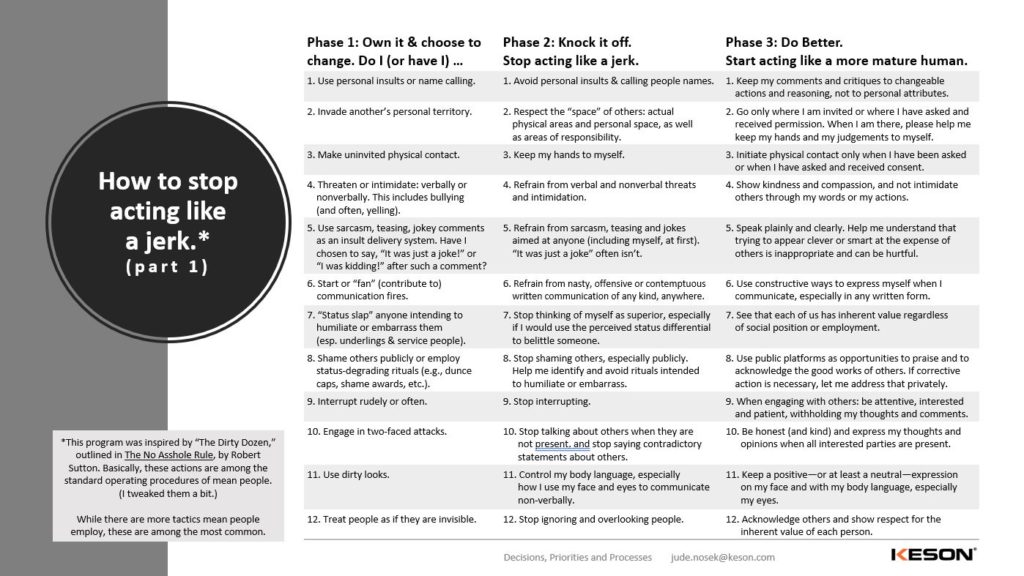
At the 2023 MCAA WOC meetings, specifically during the contractor round table, the topic of how to deal with these mean clowns came up. Over the course of the year, this topic kept coming up in a number of communities of which I am a member. This awakened an idea in me about incorporating some of the concepts from Sutton's book into my everyday life. I looked for a behavioral cheat sheet or quick guide on the "dos and do not's" around this type of behavior. I went back to Sutton and found a short list I could get started on, his Dirty Dozen. (That list of behaviors with some tweaks is Phase 1 of the corrective program.) I could not find a single-page summary of what I was looking for, so I made one.
Here’s the Simple Process and The Cheat Sheet:
Phase 1: Own it. Be on the lookout for bad behavior. I try not to make excuses as to why I behaved as I did. As some have been kind to point out to me: “You know who makes a lot of excuses for bad behavior? A**holes” I try to spot my own suspect actions. Then, I admit it in the same situation or media where it occurred and apologize for it. For example, if I acted like a jackass in a group setting, I apologize in that same group setting. If I sent an email that could have been kinder, my apology goes out to the same recipients. Next, I forgive myself (and others). Then, I can move to the next two Phases.
Phase 2: Knock it off. The “Stop Acting like a Jerk” list is intended to help me avoid my bad behaviors.
Phase 3: Do better. The “Start Doing Better” list is my ask to replace my bad behaviors with positive choices and actions.
For those inclined to ask for help from a deeper or higher power, I have found that adding the phrase “Please help me …” in front of actions to stop in Phase 2 and in front of the better actions to start in Phase 3 works quite well. I use this to orient myself to be of service at work, at home and in my other communities. I am far from perfect and sometimes catch myself or am reminded by others that my choices might be lacking. I have plenty of examples of where I could have done better. Today, I am grateful to be actively striving to act like a more mature human.