In the idyllic village of Mogno, nestled in the Maggia Valley of Switzerland, sits the Church of San Giovanni Battista. This modern masonry marvel was constructed between 1992 and 1996 after an avalanche in 1986 destroyed the original 17th-century church.
Amidst the traditional Swiss village buildings made of warm-toned wood, the church stands apart with its captivating black and white striped pattern and uncommon shape. San Giovanni Battista was rebuilt better than ever in its original site as a symbol of rebirth and renewed strength.
On the morning of April 25, 1986, an avalanche tumbled down the Swiss Alps, wiping out the nearly 300-year-old church and taking some of the town with it. The village of Mogno demonstrates the danger and allure of nature. Although not a populous area, Mogno’s serene and quaint charm attracts many tourists interested in the beauty of its mountainous woodland region. With the Swiss Alps rising over the valley village and the Maggia River running through the town, Mogno provides the perfect place for those looking to reconnect to nature.
The church itself serves as a tourist attraction both locally and internationally. San Giovanni Battista sticks out in the old village with its rounded, contemporary stone structure compared to Mogno’s more traditionally designed wooden buildings.
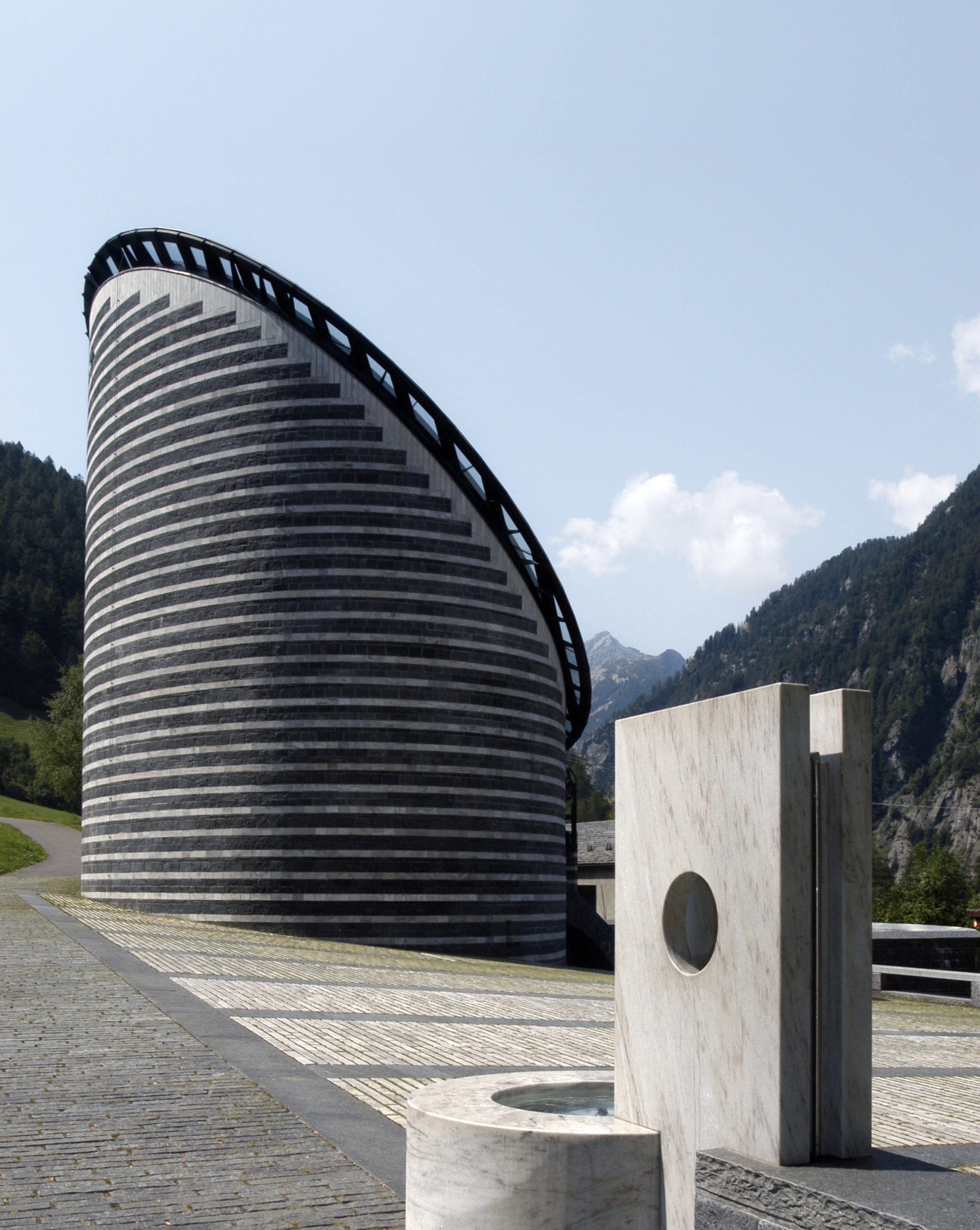
To create this modern religious space, Swiss contemporary architect Mario Botta was enlisted to design the new church. An architectural prodigy, Botta quit traditional schooling at 15 years old to pursue his passion and focus on becoming an architect. His signature postmodern architectural style is defined by his geometric designs, often creating rounded structures.
The Church of San Giovanni Battista reflects his recognizable style with the building’s exterior elliptical base, contrasting the interior rectangular room. Other notable structures designed by Botta, include the Museum of Modern Art in San Francisco, the Leeum-Samsung Museum of Art in Seoul, and Evry Cathedral in France. With his designs, Botta plays with the building’s structural shape to create an eye-catching edifice.
When Botta’s vision of what he had in mind for the new church was revealed, it caused controversy. Many argued that the design was too modern and didn’t fit the local architecture.
Ultimately, though, Botta wanted to pay homage to the old church through his modern design. In going through the wreckage of the old church, Botta salvaged the 18th-century church bells and incorporated them into the new design.
The building’s orientation remains the same and the height of the new structure matches the height of the original bell tower. The only difference is that the church’s entrance plaza used to be the original church’s cemetery. This purposeful design connects the long history of the original church to the present.
.jpg)
Botta incorporated materials from the local quarries to create a church representative of the village. Dark Gneiss, a type of metamorphic granite, creates the gray bands on the church’s walls. Gneiss has similar properties to granite because granite is considered its parent rock. However, in look and texture, they differ. Granite has a more speckled look, while Gneiss has a swirled appearance. The Dark Gneiss is mined from the Riveo quarry located in the same state as Mogno in Switzerland.
For the white bands on the walls, Peccia white marble is added in an alternating pattern. The white marble gets its name from the town of Peccia where the quarries for this type of natural stone are found. This white marble with grayish veins, also known as Cristallina, is the only marble quarried in Switzerland.
The durability of these stones reflects how this church is built to last and resist future natural disasters. Botta wanted the church to be stronger but still have delicate features like the all-glass ceiling serving as the building’s only light source.
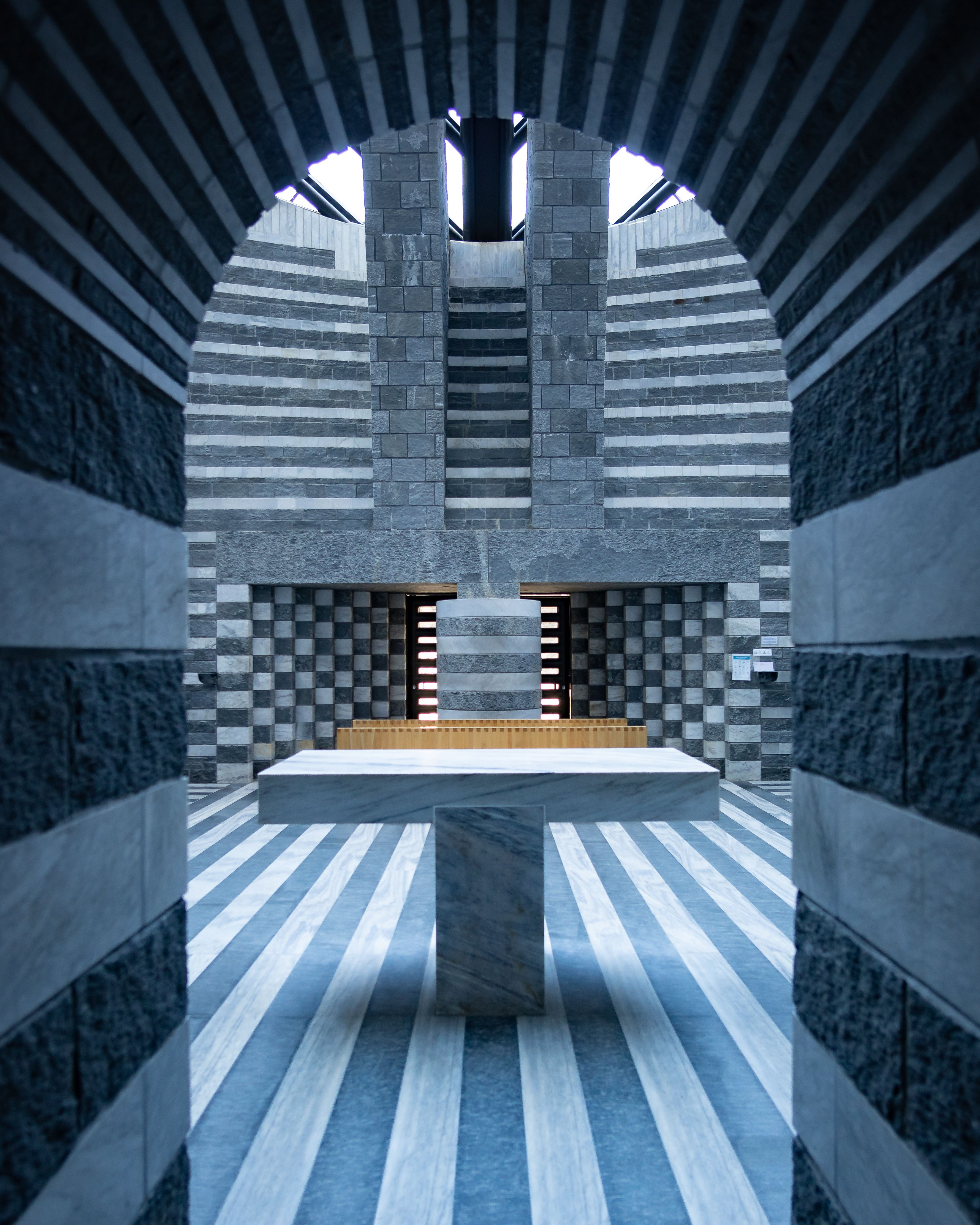
The interior church feels like stepping inside an optical illusion. The lighter-colored bands around the room brighten the space, while the dark bands define the space. As you follow the lines around the room, they lead to the glass and iron ceiling, encouraging you to gaze up into the sky and soak up the natural light.
As a small one-room church that fits only 15 people within its pews, San Giovanni Battista is an intimate setting. It is austere in details, keeping the room simple in its possessions as only an altar, three sitting areas, a crucifix, and a baptismal font take up space in the church. This room invites the visitor into a moment of contemplation and reflection without distractions.
Despite its size, there are details that make the church one of a kind. On the floor in front of the altar is an engraved list of numerals and symbols. Starting at the top is the Greek letter alpha, followed by the years 1636, 1986, and 1996. The Greek letter omega ends the list. As alpha and omega represent the beginning and end of the Greek alphabet, San Giovanni Battista represents the final reincarnation of the centuries-old church that is made to endure.
The Church of San Giovanni Battista is emblematic of the beauty of masonry. Its simplistic design showcases the strength of natural stone as well as the attention-grabbing aesthetic these stones offer. Although the 400-year-old site has faced tragedy and destruction, this modern marvel is illustrative of the resiliency and creativity of masonry design.