Tech Talk: Efflorescence
Words: Jamie Davis
Words: Jamie Davis,
Photos:
In botanical terms, it is defined as the state of flowering or blooming.
In the construction world, it is a bloom we would rather not see; that white residue marring the appearance of masonry structures, both new and old.
In its simplest terms, it is a deposit of soluble salts on the surface of masonry but when you delve deeper, it can sometimes be a telltale of larger issues.
In order for efflorescence to occur, three conditions must exist:
- A source of soluble salts
- A source of moisture
- A path for the soluble salts to reach the surface of the masonry
The source of soluble salts can come from the cement, water, aggregates, or masonry units. During new construction, the moisture source exists in the newly placed mortar and grout, and the pore structure within the masonry units and mortar provides a path for the soluble salts to make it to the surface. When the moisture evaporates, the salts are left behind on the wall as a powdery white residue. The most common efflorescence salts are sodium and potassium sulfates. These types of salts are soluble and can typically be removed with water. This type of efflorescence seen shortly after a building is constructed is also referred to as ‘new building bloom’.
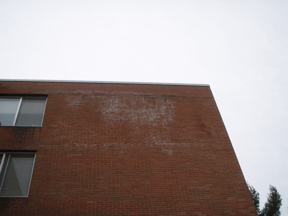
Photograph 1: New Building Bloom
Unfortunately, there is another type of efflorescence that is more insidious: calcium carbonate efflorescence. As cement hydrates, one of the byproducts of the reaction is calcium hydroxide. With larger sources of water, the calcium hydroxide contained in the mortar and grout can migrate to the surface where it reacts with carbon dioxide to form calcium carbonate (CaCO3). This type of efflorescence is not powdery; it is hard to the touch and can build up significantly on the surface (think limestone stalactite). Calcium carbonate is not soluble in water, and therefore, cannot be removed easily. It is important to know which type of efflorescence you are dealing with so you can properly address how to handle the bloom. One quick trick is to taste it! A simple salt bloom will taste salty since the salts are still soluble with water. Calcium carbonate is not soluble in water, so it will taste like…….dirt!
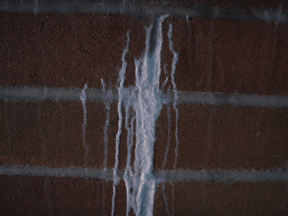
Photograph 2: Calcium Carbonate Efflorescence
The worst condition of efflorescence is known as cryptoflorescence. In this case, the water-borne salts migrate to just below the surface of the masonry and can build up enough pressure to spall the masonry. This can occur within masonry that has a dense finish like glazed brick or masonry that has been improperly coated with a non-breathable sealer.
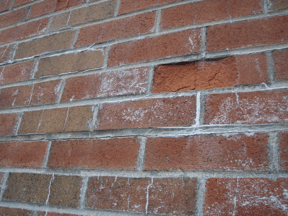
Photograph 3: Cryptoflorescence
When efflorescence occurs after the building has been in service, it is a secondary bloom. This typically indicates that a change has occurred to re-initiate the efflorescence reaction. Often, it is an indication that there is a new source of moisture within the wall.
Mitigating the potential for efflorescence should be considered during the design process, and knowing how to properly identify the type and cause of efflorescence can be a valuable tool for solving the underlying issues and determining the next steps for removal and prevention.